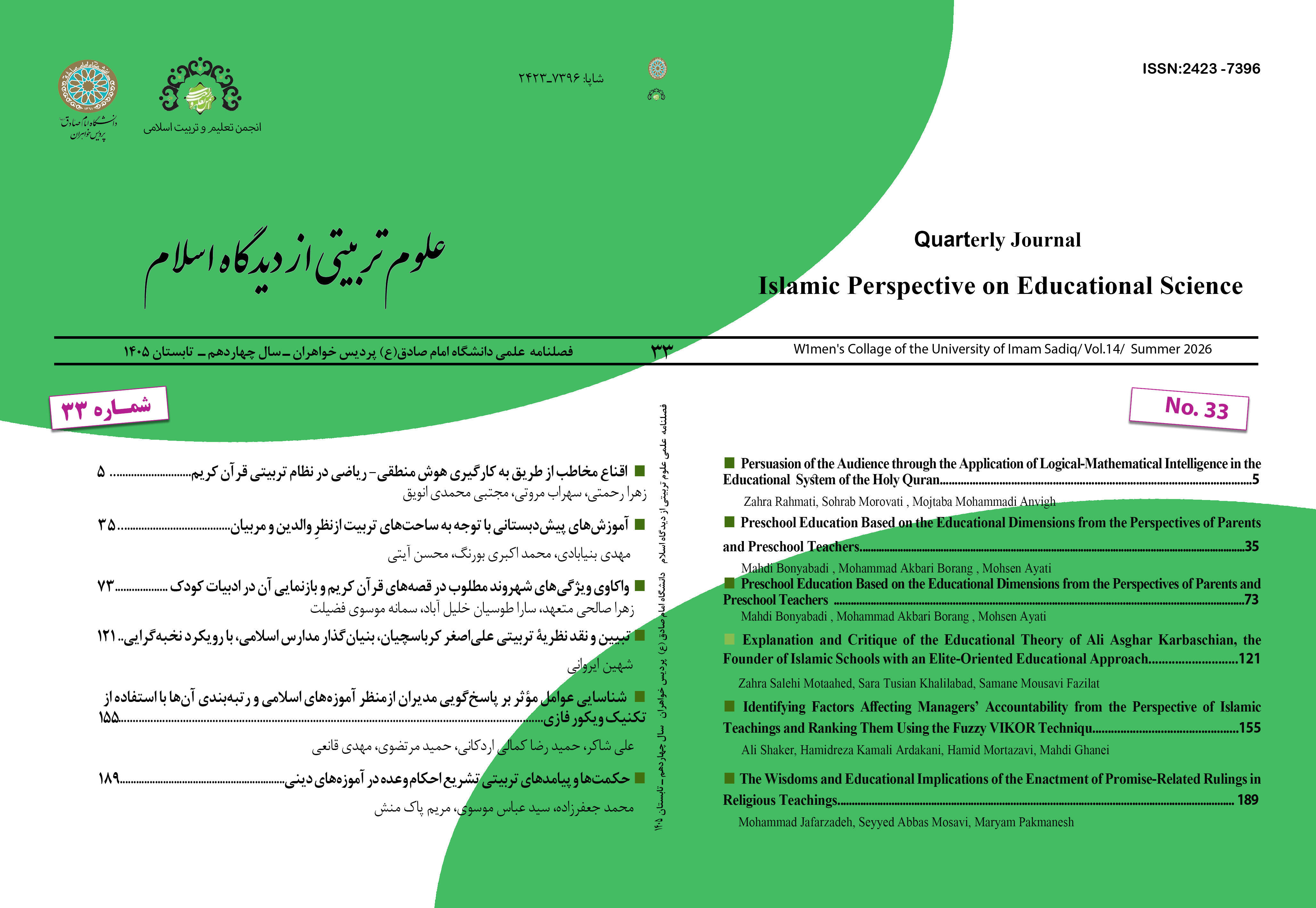
Preschool Education Based on the Educational Dimensions from the Perspectives of Parents and Preschool Teachers

Document Type : Scholarly Article

Authors
1 . PhD Student in Curriculum Planning, Department of Educational Sciences, Faculty of Educational Sciences and Psychology, University of Birjand, South Khorasan, , Iran.
2 . Associate Professor, Department of Educational Sciences, Faculty of Educational Sciences and Psychology, University of Birjand, South Khorasan, , Iran
3 . Associate Professor, Department of Educational Sciences, Faculty of Educational Sciences and Psychology, University of Birjand, South Khorasan,, Iran.
10.30497/esi.2026.248409.1957
Abstract
Introduction
Attention to this period from an educational perspective is of particular significance, as early childhood is the most sensitive and critical period for personality formation. This is due to the foundational role of children in shaping society. Preschool education, the initial phase of formal education, is the foundation for the acquisition of knowledge, skills, attitudes, and social competencies, and it is a critical factor in the cognitive, social, and emotional growth of children. Recent research has consistently shown that preschool attendance improves academic performance and social adjustment in subsequent educational stages. The Fundamental Reform Document of Education (FRDE), which was ratified in 2011, is the most significant upstream policy document in the national education system of Iran. Adopting a comprehensive and multidimensional approach, this document identifies six educational domains: social and political; religious, moral, and spiritual; scientific and technological; economic and vocational; physical and health; and artistic and esthetic. The ultimate goal of this document is to establish a comprehensive education that is founded on Islamic knowledge and revealed teachings. However, the education system is characterized by a significant disparity between the intended curriculum, as outlined in upstream policy documents, and the implemented curriculum, which is influenced by the actions of educators and families. Teachers in Iranian preschool institutions are granted significant autonomy and effectively serve as curriculum planners as a result of the absence of a codified national curriculum. Conversely, parents, who are the most significant and influential factor in their children's upbringing, establish expectations that influence their children's educational paths. Given the central role of the six educational domains in realizing the objectives of the FRDE, examining the perspectives of parents and preschool teachers regarding preschool education can provide a clear picture of the prevailing educational priorities in this period and their alignment with upstream policy documents. Consequently, the present investigation investigates the following research question: What are the viewpoints of preschool instructors and parents with respect to the educational domains regarding preschool education?
Methodology
Qualitative methodology with descriptive analytical orientation was implemented in the current investigation. Semi-structured interviews were implemented to accumulate data, which were then subjected to deductive thematic analysis. Parents and preschool instructors from preschool centers in Birjand comprised the participants. Purposive sampling was implemented, which involved the selection of teachers with a bachelor's degree in educational sciences with a specialization in preschool education and parents who were actively involved in their children's educational affairs. The sampling procedure was maintained until theoretical saturation was achieved, which led to the participation of 17 preschool teachers and 12 parents in the study. Semi-structured interviews were implemented to accumulate data. The research objectives and data confidentiality were fully explained to the participants prior to each interview, and informed consent was obtained. The interviews were verbatim transcribed from audio recordings. The data analysis was conducted in accordance with the six-phase thematic analysis framework of Braun and Clarke. This framework includes the following steps: familiarization with the data, generation of initial codes, search for themes, review of themes, definition and designation of themes, and publication of the final report. In order to guaranty the reliability of the results, Guba and Lincoln's criteria were implemented, which encompassed credibility (through member verification), transferability, confirmability (through supervisory documentation and audits), and dependability (through recoding and examining inter-coder agreement).
Findings and Discussion
Thematic analysis of the interviews produced 45 initial codes, 22 sub-themes, and 5 major themes, which were divided into five of the six domains of the FRDE. In the social and political domain, participants prioritized elements such as social adjustment, peer interaction, participation in group activities, collective life skills, and socialization. The findings revealed that parents and teachers perceive preschool as a context for learning effective communication with peers, engaging in group activities, and preparing for participation in society. Teachers placed a greater emphasis on this domain than parents, which is indicative of the institutional prioritization of social preparedness and citizenship education from early childhood. In the religious, moral, and spiritual domain, participants prioritized components such as familiarity with the Qur'an and Hadith, knowledge of God, familiarity with existence and nature, acquaintance with the Imams and religious figures, awareness of religious obligations, and the pursuit of the good life (ḥthe ṭ he goo). The parents attributed the greatest significance to this domain. This discovery is indicative of the central significance of religious values in Iranian family culture. A significant number of parents consider preschool education to be a complement to religious development within the family and anticipate that their children will become acquainted with fundamental religious concepts during this time. Basic financial concepts, identification and cultivation of talents, identification and cultivation of creativity, and introductory familiarity with occupations were the primary focus of participants in the economic and vocational domain. This discovery suggests that parents and educators do not restrict preschool education to academic preparation alone; rather, they regard it as a setting for identifying children's interests and capabilities and guiding their future endeavors. Components such as environmental conservation, personal and public hygiene, physical activity and obesity prevention, and the cultivation of healthy citizenship were extracted from the physical and health domain. Participants considered the teaching of practical health and motor skills—which develop into lifelong habits as important responsibilities of preschool centers. They were of the opinion that consistent physical activity during this period could prevent obesity and inactivity in the future. Within the artistic and aesthetic domain, participants emphasized cultivating imagination in creating artistic works, engaging multiple senses in the creative process, and valuing children's artistic productions. They perceived art as a means of promoting self-expression, imagination, and creativity, and they were of the opinion that valuing the handicrafts of children would increase their self-assurance. A comparative analysis of the perspectives of the participants revealed a significant difference: teachers prioritized the social and political domain, while parents prioritized the religious, moral, and spiritual domain. This disparity reflects differing institutional and familial priorities in education, which may result in heterogeneous educational experiences for children. The complete absence of themes related to the scientific and technological domain in the perspectives of parents and instructors is a critical finding of this study. No component that could be directly classified within this domain was identified among the themes extracted from the interviews. This discovery requires contemplation from a variety of angles. Initially, a significant number of parents and educators believe that preschool education is primarily concerned with the social, moral, and emotional development of children, with scientific and technological education being postponed until later in the educational process. Secondly, the term "technology" is often associated with digital instruments in the minds of many individuals, rather than being viewed as a context for the development of scientific thinking, curiosity, inquiry, exploration, and problem-solving skills. At the same time, the scientific and technological domain is regarded as one of the fundamental dimensions of balanced education in the transformative documents of education. The FRDE's comprehensive and monotheistic nature, which emphasizes the all-round development of human beings based on divine fiwhic (primordial nature), is explicitly contradicted by the neglect of this domain during the most sensitive period of personality formation, which not only challenges the realization of balanced and holistic education.
Conclusion
The objective of the current investigation was to ascertain the viewpoints of preschool instructors and parents with respect to preschool education, as determined by the six educational domains of Iran's Fundamental Reform Document of Education. The results indicated that the perspectives of the participants could be categorized into five domains: social and political, religious, moral, and spiritual, economic and vocational, physical and health, and artistic and esthetic. This suggests that the multidimensional approach of the FRDE is broadly supported by parents and instructors, who do not restrict preschool education to merely academic preparation. Nevertheless, the profound disparity between the upstream policies and the practical pursuits of teachers and parents is evident in the unbalanced distribution of attention across the educational domains and the complete neglect of the scientific and technological domain. The neglect of this domain during the most sensitive period of personality formation may result in the development of limited attitudes toward science and technology in children, which could distance them from one of the most important dimensions of human development. This is inconsistent with the ultimate objective of monotheistic education in Iran's educational system, which is to cultivate committed, knowledgeable, and capable human beings in all aspects of existence. The results of this investigation have a variety of practical and theoretical implications. This study contributes to the enrichment of the literature on curriculum studies and education by introducing the gap between the intended and implemented curriculum in preschool education at the theoretical level. In order to guaranty that all domains are adequately addressed, it is evident that curriculum reform, teacher professional development to integrate scientific and technological concepts, parent education to expand their expectations of preschool education, and participatory curriculum planning that involves all stakeholders are indispensable. The study's limitations include the context-specificity of the findings to Birjand and its reliance on articulated perspectives rather than observed practices. Observational methods and comparative studies across various regions may be employed to further develop these discoveries in future research. Additionally, investigating the perspectives of educational experts and specialists, as well as examining the extent of attention to upstream policy documents in preschool curriculum design, are among other research recommendations of this study. To conclude, the unbalanced distribution of attention to the educational domains and the complete absence of the scientific and technological domain reveal a significant gap between policy and practice, despite the fact that parents' and teachers' perspectives are largely consistent with the multidimensional approach of the FRDE. Addressing this gap is essential for the realization of holistic, balanced, and comprehensive child development and the successful implementation of the transformative vision of Iran's educational system.


Keywords
Subjects

Afani, K., & Alizadeh, R. (2017). Studying the effect of preschool on writing skills, social skills and health skills of first grade elementary school students in rural educational complexes in Piranshahr city. Third International Conference on Psychology, Sociology, Educational Sciences and Social Studies, Kharazmi Institute of Science and Technology, Shiraz. (In Persian)
Aghajan, M., & Emami Koopai, S. (2024). Identifying the influential components of architecture on child education, based on the Islamic approach: Preschool educational spaces. Educational Sciences from an Islamic Perspective, 12(25), 139–171. https://doi.org/10.30497/esi.2024.244960.1651
Aghajanbeglu, S., Eissazadeh, F., & Eissazadeh, A. (2015). Investigating the effect of group work on learning life skills among elementary school students in Bushehr. The First International Conference on Humanities with an Indigenous-Islamic Approach and Emphasizing New Research, Payam Noor University, Sari Branch. (In Persian)
Ahmadi, G. A. (2006). Investigating the degree of consistency and coordination among the intended, implemented, and attained curricula in the new elementary science curriculum. Quarterly Journal of the Institute for Educational Research, 86(22), 51–92. (In Persian)
Ahmadi, S. (2014). School curriculum planning: A strategic axis for decentralizing the curriculum planning system. First National Conference on Sustainable Development in Educational Sciences and Psychology, Social and Cultural Studies, Tehran. (In Persian)
Akhlaqi, A., Salehsedghpour, B., & Navid Adham, M. (2020). Future studies of the goals of the Fundamental Transformation Document of Education on the horizon 2025. Strategic Studies of Public Policy, 10(34), 56–80. (In Persian)
Altuni, D., Heidari, N., Sanei, K., & Mohammadi, M. (2016). Investigating the effect of friends and peers on the classroom behavior of elementary school students. The Second National Conference on Knowledge and Technology of Educational Sciences, Social Studies and Psychology of Iran. (In Persian)
Berry, D., & O'Connor, E. (2010). Teacher–child relationships and social skill development across middle childhood: A child-by-environment analysis of change. Journal of Applied Developmental Psychology, 31(1), 1–14. https://doi.org/10.1016/j.appdev.2009.05.001
Birmipour, A., & Askari, Y. (2018). Cognitive education in preschool. Proceedings of the 10th National Education Conference, Shahid Rajaee Teacher Training University, Tehran. (In Persian)
Bitarfan, F., Sojoodi, M., & Dehghani, M. (2020). Investigating the obstacles to the implementation of the Document of Fundamental Educational Transformation based on the Fullen model: A case study of the aesthetic and artistic education dimension. Research in Curriculum, 17(40), 90–110. (In Persian)
Bulut, S., Bukhori, B., & Parsakia, K. (2024). Enhancing selective attention in children with learning disorders: Efficacy of executive functions training. KMAN Counseling & Psychology Nexus, 1(2), 86–93. http://doi.org/10.61838/kman.psynexus.1.2.14
Ebrahimi, A., Ghasemi, G., & Samouei, R. (2013). The role of preschool education in the social development of first grade elementary school students in Isfahan. Behavioral Science Research, 10(6), 1–6. (In Persian)
Fallah, A., Ahmadi, P., & Rezazadeh Shiraz, F. B. (2015). Professional competence of preschool teachers. Teaching and Learning Research, 2(6), 165–182. (In Persian)
Fathi Vajargah, K. (2005). Principles of curriculum planning. Tehran: Iran-Zamin. (In Persian)
Furnari, E. C., Whittaker, J., Kinzie, M., & DeCoster, J. (2017). Factors associated with accuracy in prekindergarten teacher ratings of students' mathematics skills. Journal of Psychoeducational Assessment, 35(4), 410–423.
Ghafari, K., Davoodi, H., & Sarlak, M. (2018). Investigating the effect of preschool education on the development of social skills and academic achievement of first grade elementary school students. Quarterly Journal of Educational Leadership and Management, Islamic Azad University, Garmsar Branch, 12(3). (In Persian)
Kakia, L., Popov, N., & Madanda Arani, A. (2015). A comparison of parents' and teachers' evaluations about school readiness among first-grade pupils of primary schools in Tehran. Cogent Education, 2(1).
Kelly, A. V. (2009). The curriculum: Theory and practice (6th ed.). Sage Publications.
Khadivi, A. (2018). Investigating the effect of using the Montessori method on the level of socialization of preschool children in the 4th district of Tabriz. Sociology of Education, 4, 47–62. (In Persian)
Khodabandeh Lou, R., Mehran, G., Mohseni, H., & Rajabi, F. (2018). A study of professional development in preschool education: A review of research conducted in the past 36 years. New Educational Thoughts, 15(1), 7–26. https://doiorg/10.22051/jontoe.2019.18878.2096 (In Persian)
Mirzazadeh, K., Shahriariahmadi, M., & Eskandarnezhad, G. (2014). Comparison of the effectiveness of two storytelling methods through visualization and pantomime on emotional dyslexia of children with hearing problems. Early Childhood Health and Education, 4(4), 119–128. http://dx.doi.org/10.32592/jeche.5.3.93 (In Persian)
Monica, J. (2003). A study of textbooks as the potentially implemented curriculum (Master's thesis). Luleå University of Technology, Sweden.
Mousavi, A., Sheikh Elahi, M., Vazirinejad, R., & Rezaian, M. (2019). Studying the prevalence of obesity and overweight in preschool children in Rafsanjan, Iran, in 2018. Journal of Rafsanjan University of Medical Sciences, 18, 951–958. (In Persian)
Mullis, I. V. S., Martin, M. O., & Kennedy, A. M. (2003). PIRLS 2001 international report: IEA's study of reading literacy achievement in primary schools. Boston College.
Orouji Aghdam, Z., Atadokht, A., & Basharpoor, S. (2020). The effectiveness of parent-child relationship-based game therapy on quality of life in preschool children. Quarterly Journal of Health Promotion Management, 9(3), 1–9. (In Persian)
Osakwe, R. N. (2009). The effect of early childhood education experience on the academic performance of primary school children. Studies on Home and Community Science, 3(2), 143–147.
Parsakia, K., Farzad, V., & Rostami, M. (2023). The mediating role of attachment styles in the relationship between marital intimacy and self-differentiation in couples. Applied Family Therapy Journal, 4(1), 589–607. http://dx.doi.org/10.18502/qjcr.v20i77.6144 (In Persian)
Piri, R., & Adib, Y. (2009). Optimal curriculum model for preschool. Education and Evaluation, 2(5), 53–82. (In Persian)
Pourkarim, S., & Masoumifard, V. (2017). The effect of completing preschool among elementary school students. Studies in Psychology and Educational Sciences, 3(2/2), 75–86. (In Persian)
Rahbari, M., Belbasi, M., & Qorbi, S. M. (2015). National identity in the Document of Educational Transformation of the Islamic Republic of Iran. Quarterly Journal of National Studies, 16(1), 45–66. (In Persian)
Rahiminia, S., & Zora, T. (2015). The role of peers on students’ classroom behavior. The Second National Conference on Sustainable Development in Educational Sciences and Psychology, Social and Cultural Studies. (In Persian)
Rastegar, A., & Najafzadeh, M. (2015). The relationship between the level of attention of preschool teachers to environmental education and promoting environmental culture of preschool children. International Conference on Architecture, Urban Planning, Civil Engineering, Art and Environment; Future Horizons Looking Back. (In Persian)
Robitaille, D. F., Schmidt, W. H., Raizen, S. A., McKnight, C. C., Britton, E. D., & Nicol, C. (1993). Curriculum frameworks for mathematics and science. Pacific Educational Press.
Saadati, N., & Parsakia, K. (2023). The predictive role of parents' marital relationship quality on adolescents' psychological capital. Journal of Adolescent and Youth Psychological Studies, 4(8), 139–146. (In Persian)
Sajjadi Anari, S., Afrooz, G., & Zabeti Arani, M. (2011). Analysis of mothers' attitudes toward cognitive-social skills of preschool children. Early Childhood Health and Education, 2(2), 27–45. (In Persian)
Sajjadieh, N., & Azadmanesh, S. (2013). A critical review of the detailed objectives of preschool activities in the national curriculum of the Islamic Republic of Iran from the perspective of the Islamic approach to action. Curriculum Theory and Practice, 1(2), 65–98. (In Persian)
Samiei, F., Baghban, I., Abedi, M. R., & Hosseinian, S. (2016). Career aspirations of preschool and elementary school children in Isfahan. Career and Organizational Consulting Quarterly, 8(26), 9–28. (In Persian)
Schmidt, W. H., McKnight, C. C., Valverde, G. A., Houang, R. T., & Wiley, D. E. (1997). Many visions, many aims: A cross-national investigation of curricular intentions in school mathematics (Vol. 1). Kluwer Academic Publishers.
Secer, Z., Nadir, C., Sezai, K., Fahri, S., & Gokhan, K. (2009). Social skills and problem behaviour of children with different cognitive styles who attend preschool education. Procedia – Social and Behavioral Sciences, 1(1), 1554–1558. https://doi.org/10.1016/j.sbspro.2009.01.273
Sharifzadeh, H., Hejati, H., & Sharifnia, M. (2010). Investigating the effect of preschool education on health awareness of first grade elementary school students. Journal of Urmia School of Nursing and Midwifery, 9(2), 90–96. (In Persian)
Sharifi, M. A. (2025). Child-rearing methods from the perspective of Imam Ali (AS). Islamic Knowledge and Educational Sciences, 11(22), 61–80. (In Persian)
Shirbeigi, N., Azizi, N., & Amiri, S. (2015). Exploring the concept of participation and intervention in children's education from the perspective of parents and teachers. Journal of Educational Sciences, 22(6), 21–54. (In Persian)
Sobhi Qaramaleki, N., Jajloo, N., & Mohammadi, S. (2015). Investigating the effectiveness of life skills training and social adaptations of preschool children. Journal of School Psychology, 3(5), 118–131. (In Persian)
Taheri, M., Jalili, Z., Abbaspour, A., & Gandomkar, R. (2024). Meaning-making of school principals in the process of implementing the fundamental transformation document of education. Educational Sciences from the Perspective of Islam, 12(26), 51–78. https://doi.org/10.30497/esi.2024.246111.1763 (In Persian)
Talebzadeh Nobarian, M., Saleh Sedgpour, B., & Keramati, A. (2015). Investigating the effect of the social climate of secondary schools on the development of students’ social skills. Quarterly Journal of Educational Studies, 2(8), 23–47. (In Persian)
Tayyibi, Z., & Ghoruri, S. (2017). Methodology of teaching the Qur'an and religious concepts to children in the life of the Prophet (PBUH) and the Ahlul Bayt (AS). National Conference on Subject-Educational Knowledge: Religious Education and the Elementary Qur'an. (In Persian)
UNESCO. (2021). Reimagining our futures together: A new social contract for education. UNESCO. https://unesdoc.unesco.org/ark:/48223/pf0000379707
Vafaei, R., Fazlollah Ghomshi, S., & Taleifard, A. (2017). Investigating the level of attention to the six dimensions of the document of educational transformation in primary school social studies textbooks. Applied Issues of Education and Training, 2(2), 131–154. (In Persian)
Vahedi, S., & Fathi Azar, E. (2006). Social competence training in reducing aggression in preschool boys: A report of 6 cases. Quarterly Journal of Mental Health, 8(31), 131–140. (In Persian)
Yahyavi, S., Zeinaly Azim, A., & Honarjoo, M. (2013). Evaluating the effect of postmodernism aesthetic elements in the design of kindergarten spaces. Early Childhood Health and Education, 4(3), 1–16. http://dx.doi.org/10.32592/jeche.4.3.1 (In Persian)


  • Receive Date 31 May 2025
  • Revise Date 24 October 2025
  • Accept Date 21 July 2026
  • First Publish Date 21 July 2026
  • Publish Date 22 June 2026